

You’ve felt the pain of a bad dispatch. A technician shows up late; or worse, arrives without the certification or experience the job requires. The client calls, the project manager scrambles, and a straightforward installation can turn into a week-long scheduling problem.
That’s the problem AV dispatch optimization is designed to solve.
At its core, dispatch optimization means matching the right technician to the right job at the right time. But effective dispatch is about more than generating a schedule. It requires accurate technician data, clearly defined job requirements, geographic coverage, reliable communication, and a process for holding everyone accountable.
For Pro AV teams managing projects across multiple markets, that combination can mean fewer delays, less rework, and a more predictable client experience. The human elements of accountability and trust in Pro AV dispatching matter just as much as the technology when you’re staffing AV projects nationwide.
Why AV dispatch optimization matters for Pro AV teams
Getting dispatch right isn’t simply an administrative task. A poor technician match can create a chain reaction: missed install windows, site-contact frustration, additional truck rolls, project delays, and more work for an already stretched coordination team.
Consider a videoconferencing installation that requires experience with specific equipment. Assigning the closest available technician may look efficient on paper, but if that technician doesn’t have the required experience, the apparent time savings can quickly disappear.

The problem becomes even more significant as project volume grows. Retailers running rollouts across 40 states needs dispatch scheduling that holds up across every market, every time zone, and every local labor pool. Without a system for matching skills to job requirements, coordinators end up m
A regional integrator may be able to manage technician relationships manually. A national rollout involving dozens of markets requires something more structured. Coordinators need to know:
Which technicians are qualified for the specific scope
Which certifications are current
Where technicians are located
Who is actually available
Which technicians have a history of successful closeouts
Where backup coverage exists if someone cancels
The goal isn’t simply to find the closest technician. It’s to find the closest qualified technician who can successfully complete the work.
The financial weight of poor matching
A bad dispatch costs more than the original service call.
If the wrong technician arrives, the consequences can include a second truck roll, additional coordination, delayed billing, rework, and an unhappy client. Repeated issues can also put pressure on the relationship between an integrator and its end customer.
| Factor | Poor Dispatch Matching | Optimized Dispatch |
|---|---|---|
| Technician assignment | Based primarily on availability | Based on skills, location, availability, and scope |
| Arrival | Increased risk of delays | Planned around the required service window |
| First-time completion | Higher risk of rework | Better match between technician and job |
| Documentation | May be incomplete or delayed | Closeout requirements established in advance |
| Client experience | More disruptions and follow-up | More predictable delivery |
The financial impact isn’t always visible on the original work order. A callback might appear as a single additional expense, while the coordinator time, project delay, and client-management effort behind it remain scattered across the organization.
That is why dispatch should be measured as part of the overall service process—not just as a scheduling function.
Certification gaps create hidden liability
Beyond cost, there’s a liability angle that gets overlooked. Sending an uncertified technician to a job that requires CTS or manufacturer-specific credentials exposes you to compliance risk with clients who have their own vendor requirements. Retail and corporate clients increasingly audit technician credentials as part of their vendor scorecards, and a single flagged incident can jeopardize a broader account relationship. Optimized AV staffing processes catch these gaps before the technician ever leaves for the site, not after the client complains. This is exactly why Mega maintains a vetted network of over 2,000 certified subcontracted AV technicians, so the matching happens before dispatch, not after a failed visit.
How to optimize AV dispatch scheduling
Optimizing dispatch starts with treating it as a discipline, it sits alongside the other field service management best practices for Pro AV teams. Effective dispatch starts with a repeatable process.
A skills-first dispatch process verifies those requirements before the technician leaves for the job.
A useful technician database should track information such as:
CTS and other relevant certifications
Manufacturer-specific credentials
Experience with required equipment
Geographic coverage
Availability
Historical job performance
Credential expiration and verification status
This turns technician selection from a phone-tree exercise into a qualified shortlist.
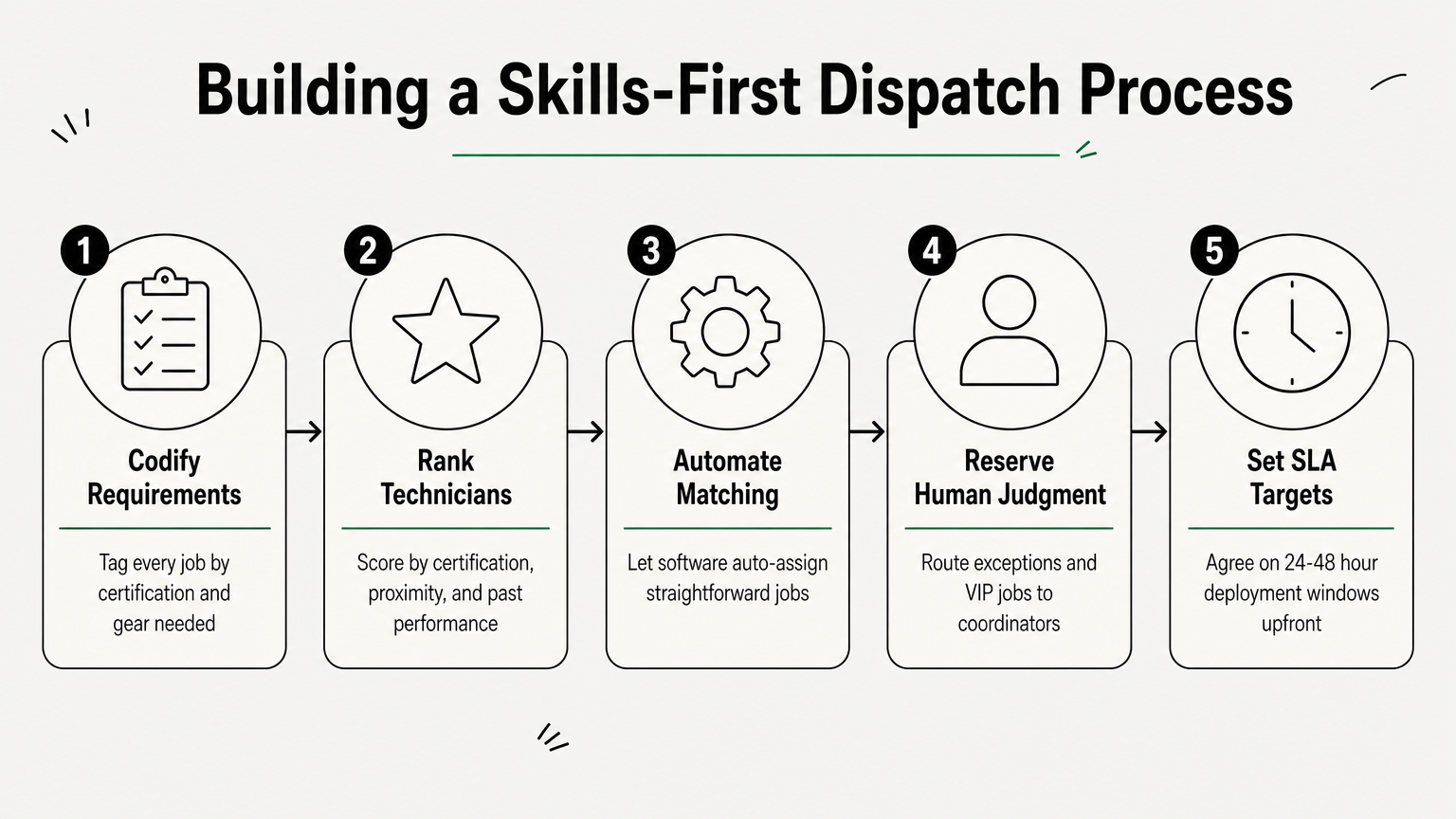
Build a skills-first matching process
Start by codifying what each job actually requires, down to the manufacturer certification and the specific gear on site. A structured matching process should include:
- A skills database tagged by certification (CTS, Crestron, Shure, Biamp)
- Geographic radius rules so you’re not flying a tech across three states for a two-hour job
- Historical performance scores that flag techs with strong closeout records
- Automatic exclusion of anyone with an expired or unverified credential
This groundwork turns technician scheduling from a guessing game into a filtered shortlist your coordinators can act on in minutes.
Start by defining exactly what each job requires.
Instead of simply entering “AV technician,” capture the details that determine whether someone can actually complete the work: equipment, manufacturer, certification, scope, location, arrival window, and expected deliverables. Then compare those requirements against current technician data. The result is a much more useful question than “Who is available?”
It’s:
“Who is qualified, available, and positioned to complete this job successfully?”
Automate the routine, keep humans on exceptions
Software can handle much of the repetitive work involved in technician scheduling.
Rules can help filter candidates based on:
Certification requirements
Geographic radius
Availability
Equipment experience
Job history
Service-level requirements
That allows coordinators to spend less time searching through technician lists and more time handling exceptions. Human judgment still matters. Last-minute cancellations, VIP customers, complex scopes, and multi-site rollouts can require decisions that don’t fit neatly into an algorithm. The best approach is to automate the routine while keeping people involved where judgment adds value.
Set service-level expectations upfront
Response-time expectations should be established before a job is assigned. If a project requires deployment within 24 to 48 hours, the coordinator, technician, and client-facing team should understand that expectation from the beginning. Clear service-level agreements create a shared benchmark for everyone involved and make it easier to identify where a process is breaking down.
Metrics that prove your dispatch optimization is working
A dispatch process isn’t optimized simply because it feels more organized. The results should show up in measurable performance. Focus on metrics that connect technician assignment to client experience and operational cost.
| Metric | What it tells you | Example benchmark |
|---|---|---|
| Dispatch-to-arrival time | How quickly jobs are matched and deployed | 24–48 hours |
| First-time fix rate | Whether the assigned technician had the right skills and scope | 90%+ |
| Callback rate | Frequency of rework or incomplete jobs | Under 5% |
| Documentation completion | Whether jobs are ready for billing and closeout | 100% same-day |
| Technician utilization | Whether technician capacity is balanced | 70–85% |
The exact benchmarks will vary by organization and project type, but the principle is consistent: measure the outcome of the dispatch, not just the speed of the assignment.
For example, reducing dispatch time isn’t necessarily an improvement if it results in more callbacks. Likewise, maximizing technician utilization doesn’t help if the most reliable technicians become consistently overbooked.
Turn data into continuous improvement
Metrics become valuable when teams act on them. A rising callback rate could indicate that job scopes aren’t detailed enough, that technician credentials aren’t being verified, or that certain markets lack the right skills. Low utilization might indicate excess capacity or geographic mismatches. Consistently high utilization could signal that additional technicians are needed in a particular market. Regular reviews turn dispatch data into a feedback loop rather than a report that gets filed away.

Last-minute cancellations and no-shows
A technician cancellation the night before an installation can quickly become a client-facing problem—especially when the replacement needs specific credentials. Maintaining a backup bench of pre-vetted technicians gives coordinators options when the original assignment falls through. The objective is simple: a technician cancellation should trigger a replacement process, not a crisis. You can book a replacement MegaTech on short notice. A backup bench turns a cancellation into a non-event instead of a crisis call.
Coverage gaps in secondary markets
National rollouts can be difficult in smaller cities where the local technician pool is limited. Teams can prepare for these markets by:
Pre-qualifying technicians before a rollout begins
Identifying backup technicians in advance
Expanding geographic radius rules where necessary
Working with staffing partners that already have established local coverage
Planning coverage before a project starts is considerably easier than trying to build a technician network after an installation has already been scheduled.
Stale technician information
Technician availability and credentials change constantly. Certifications expire. Technicians move between markets. Availability changes. Phone numbers and contact information become outdated. A dispatch system is only as accurate as the information behind it, so technician records should be reviewed and refreshed regularly.
Communication breakdowns
Even a perfect technician match can fail if the scope isn’t communicated clearly. Before dispatch, the technician should have the information needed to succeed on site, including:
Job scope
Site address and access instructions
Site contact
Arrival window
Required equipment or credentials
Expected deliverables
Documentation requirements
A standardized pre-dispatch checklist can close the gap between assigning a technician and actually preparing that technician for the job.
Certainty starts with smarter dispatch
AV dispatch optimization isn’t about removing people from the process. It’s about giving coordinators better information and a repeatable system for making decisions. The strongest processes combine four things:
Skills-first matching ensures the technician can perform the work.
Accurate availability and geographic data makes the assignment practical.
Clear communication and service-level expectations give everyone the same definition of success.
Performance metrics show whether the process is actually improving results.
Technology can support all four, but technology alone doesn’t create a reliable dispatch operation. The underlying technician data, qualification process, communication standards, and accountability have to be there first. For Pro AV teams, that means moving away from “Who can take this job?” and toward “Who is the right technician for this job, and how quickly can we get them there?”
Building and maintaining a qualified technician network takes time, especially when projects span multiple states and require specific certifications, equipment experience, or short deployment windows.
Need qualified AV technicians for your next project?
Mega Services helps Pro AV teams book vetted AV technicians for installation, service, and field-support projects. With a network of more than 2,000 certified subcontracted AV technicians, Mega can help integrators find qualified field support across a broad range of markets.
If you’re spending too much time searching for coverage, verifying credentials, or finding replacements when a technician cancels, Mega Services for booking techs can give your team another way to manage those demands. Request information about certified AV technician dispatch for your next project, and start replacing scheduling guesswork with certainty.
Mega Has The Staffing Solutions You Need For Your Next Pro AV Project.
Let MegaServices help you grow your business by providing you with the qualified personnel you need when you need them.
Allie Linarez is a Senior Billing Specialist at MegaServices LLC. As one of Mega’s earliest team members, Allie has grown with the company and contributed to many of the processes used today. Her adaptability, organization, and attention to detail make her a trusted part of Mega’s service-side billing operations.
