

You’ve probably heard vendors pitch new displays, conferencing systems, or other AV equipment as a way to modernize your business. But business transformation through Pro AV means more than replacing outdated hardware. It happens when integrated audio-visual systems improve how teams communicate, how quickly projects move forward, and how reliably an organization can scale across multiple locations without adding permanent headcount.
For project managers and service coordinators, the real question is whether a Pro AV investment will improve operations or simply create another system to maintain. The answer depends heavily on execution. Certified technicians, consistent commissioning, accurate documentation, and reliable deployment determine whether new technology becomes a productivity improvement or an ongoing source of support issues.
This article explores what business transformation through Pro AV looks like in practice, from the operational impact of integrated AV to the staffing and certification standards required to deploy systems consistently across markets.
Why Business Transformation Through Pro AV Matters
Organizations can easily think of Pro AV as a purchasing decision: select the equipment, schedule the installation, and move on to the next project. In practice, the impact goes much further. Integrated AV systems can change how quickly a regional team gets a conference room online, how efficiently a retailer launches digital signage across hundreds of locations, or how much time employees spend troubleshooting meeting-room technology.
The business impact can show up in several places:
Faster project closeout: Proper commissioning and documentation reduce punch-list work after installation.
Fewer support issues: Systems installed and tested correctly are less likely to generate recurring service tickets.
More consistent multi-site deployments: Standardized installation practices make it easier to replicate the same solution across markets.
Better employee experience: Meeting rooms and collaboration spaces work as expected instead of becoming a daily technology obstacle.
More flexible staffing: Organizations can scale technical labor around project demand instead of maintaining permanent headcount for occasional spikes.
That is the practical side of transformation: technology becomes an operational asset instead of another source of friction.
The Gap Between Buying Gear and Getting Results
Most organizations already have access to capable AV hardware. The challenge is turning that equipment into a reliable working system.
A display, codec, microphone, or control processor cannot deliver its intended value if it is improperly installed, inadequately tested, or poorly documented. The difference often comes down to the technicians responsible for deployment.
Certified technicians can install systems according to manufacturer requirements, identify problems during commissioning, and leave documentation that facilities and IT teams can actually use after the project is complete.
A display or codec doesn’t transform anything by itself. The installation, commissioning, and handoff are what turn equipment into an operational solution.
That distinction becomes even more important when the same technology needs to be deployed across dozens or hundreds of locations.
Why this matters more now than five years ago
Hybrid work, distributed retail footprints, corporate campuses, healthcare networks, and educational institutions all rely more heavily on video and audio systems as part of everyday operations. Modern AV projects can involve everything from initial discovery through commissioning across the six essential project phases of an AV integration making consistency throughout the process increasingly important.
At the same time, organizations may need qualified technicians in multiple markets at the same time. Having equipment ready does not guarantee that the right technician will be available when the project schedule requires one. That creates a practical bottleneck: an organization can have the hardware, the budget, and the rollout plan, but still lose time waiting for qualified technical labor.
What’s at Stake Operationally
When AV deployment is poorly managed, the effects can extend well beyond the installation itself.
Project timelines: A missed technician appointment can push a multi-site rollout back days or weeks.
Reputation: A poorly executed installation at a client-facing location can reflect on the organization responsible for the project.
Billing speed: Complete documentation and sign-off make it easier to close projects and move invoices forward.
Team productivity: Employees lose time when meeting spaces or collaboration systems require troubleshooting.
Field-team confidence: Repeated delays and incomplete installations can make future AV projects harder to manage.
These operational consequences are why technical labor should be treated as part of the project strategy rather than an afterthought.
How to drive transformation with Pro AV integration
How to Drive Transformation with Pro AV Integration
The most effective approach is to treat Pro AV integration as an operational workflow from the beginning. Before the first cable is pulled, the project should establish who will assess the site, which technicians will perform the work, how commissioning will be handled, and who will approve the final documentation.
A simple four-step process can provide a repeatable foundation:
Site assessment → Technician assignment → Commissioning and testing → Documentation handoff
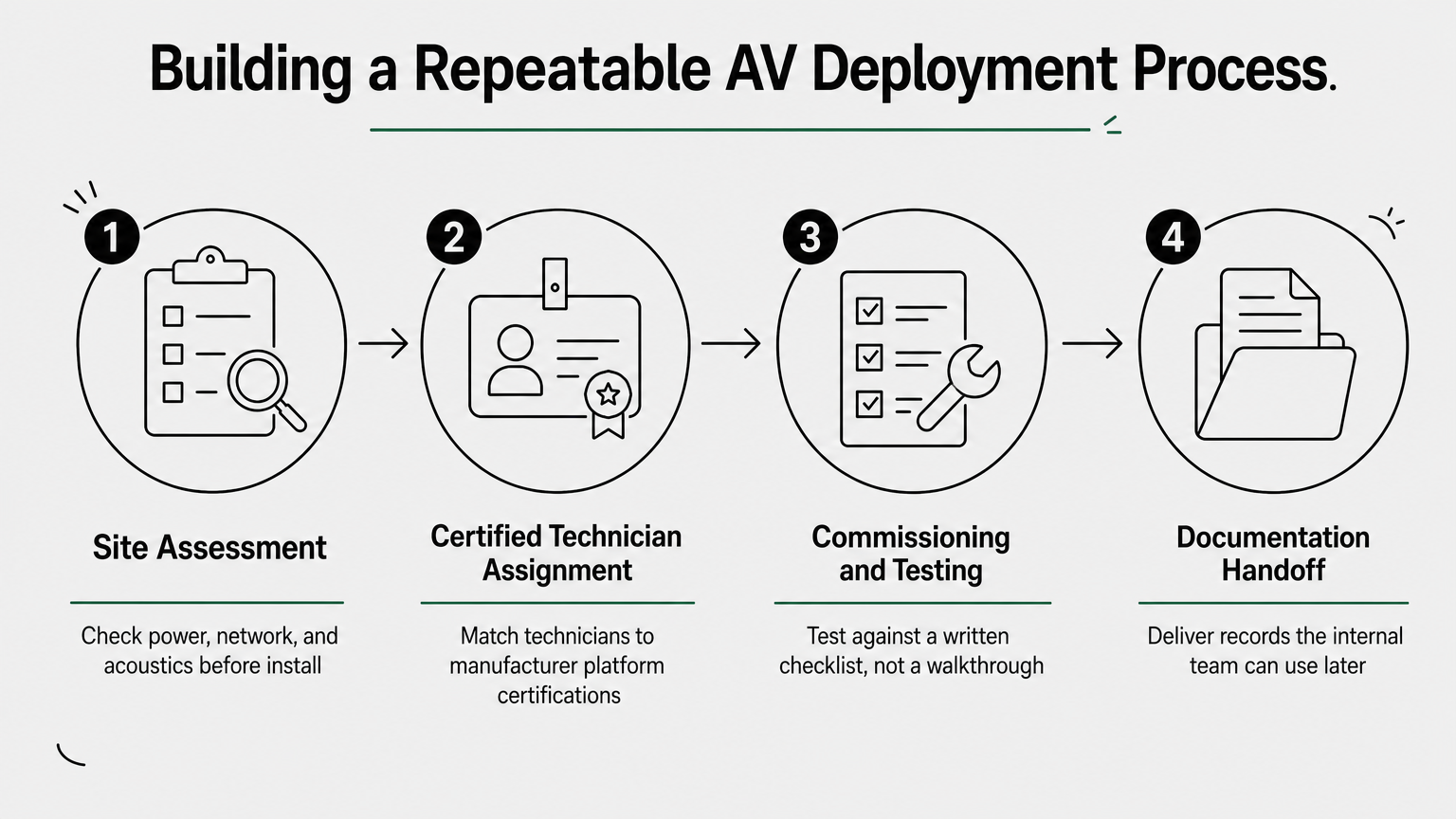
Building a Repeatable Deployment Process
A scalable AV deployment process should include:
Site assessment: Identify power, network, mounting, acoustic, and infrastructure issues before installation begins.
Certified technician assignment: Match technicians to the manufacturer platforms and technical requirements involved in the project, including systems from Crestron, Biamp, Shure, and similar manufacturers.
Commissioning and testing: Verify system performance against a documented checklist rather than relying on an informal walkthrough.
Documentation handoff: Provide facilities and IT teams with accurate information they can reference after the installer leaves.
The goal is consistency. When the process can be repeated from one location to the next, organizations can scale an AV rollout without reinventing the workflow at every site.
Sourcing the Labor Behind the Deployment
Internal teams rarely have enough technical staff to support every market where an AV rollout may occur. Hiring full-time technicians for temporary project demand can also create unnecessary overhead.
That is where technical staffing augmentation can provide flexibility. Mega Services structures its technical staffing and AV project management support
around this model, helping organizations deploy technicians across multiple markets while maintaining consistent project standards. Technicians can be deployed in 24 to 48 hours, with documentation and project requirements established as part of the work order.
For a national rollout across a dozen cities, that means the same deployment expectations can be applied across locations rather than relying on whatever local labor happens to be available
Where Pro AV Delivers the Biggest Business Impact
The benefits of consistent audio visual system integration are particularly visible in environments where the same technology must be deployed repeatedly. Multi-site retailers, corporate campuses, healthcare networks, and higher-education organizations may have dozens or hundreds of locations using similar systems. A small deployment problem can therefore become a much larger operational issue when repeated across multiple sites.
Get the process right once, and it becomes a template.

Retail and Multi-Site Rollouts
National retail chains use digital signage installation, in-store audio, video walls, and other AV technologies to maintain consistent customer experiences across locations. For a 200-store rollout, a missed technician appointment in one market can create a gap in an otherwise coordinated launch. Consistent commissioning and documentation help ensure that each location is ready for the same go-live date. The objective isn’t simply to install identical hardware. It is to deliver consistent performance across every location.
Corporate Campuses and Hybrid Meeting Spaces
Corporate environments experience the impact differently.
When conferencing systems are properly installed and tested, employees can enter a meeting room and start a call without spending the first several minutes troubleshooting microphones, displays, cameras, or control systems.
Across hundreds of rooms and thousands of meetings, those small improvements can become meaningful operational gains.
The biggest business impact isn’t necessarily the newest display. It’s the meeting that starts on time in every room, every day.
| Environment | Where impact shows up |
|---|---|
| Retail chains | Synchronized signage rollouts, faster store openings |
| Corporate campuses | Fewer meeting delays, lower IT ticket volume |
| Healthcare networks | Reliable VTC for consults, compliant documentation |
| Higher education | Classroom AV uptime, reduced help desk load |
Overcoming Staffing and Implementation Hurdles
For project managers running multi-site AV deployments, one of the most difficult parts of the process can be finding qualified technicians when the schedule demands them.
Local labor markets can become especially competitive when multiple retailers, integrators, or other organizations need technicians with the same manufacturer-specific skills.
The result is often a mismatch between the project schedule and available technical labor.
The Most Common Breakdowns
Several issues consistently create delays:
No-shows or last-minute cancellations from unvetted subcontractors.
Mismatched skill sets, where a technician arrives without the required manufacturer certification.
Incomplete documentation that leaves facilities teams without the information they need later.
Slow escalation when an issue arises during installation and the project team cannot quickly reach qualified support.
The challenge isn’t simply finding someone who can install AV equipment. It’s finding someone with the right experience and credentials who can perform the work when the project needs it.
Flexible, Vetted Staffing
Solving the staffing challenge does not necessarily require expanding the internal team or committing to a long-term staffing contract. A flexible model gives organizations access to a network of subcontracted AV technicians across the markets where projects are taking place, with credentials verified before work is assigned.
Mega Services deploys Mega Certified technicians within 24 to 48 hours across the U.S. and Canada, matching technicians to the specific platform certifications required for the project. The model is designed without minimums or subscriptions, giving project managers the ability to scale technical resources around actual project demand. That flexibility can be particularly valuable for large deployments where several markets must move forward on the same schedule. The approach is demonstrated in this Fortune 500 national scheduling panel rollout where coordinated technical labor was critical to completing a distributed deployment.
Turning AV Investment into Lasting Change
Business transformation through Pro AV isn’t simply about buying better equipment. It is about building a deployment process that allows that equipment to deliver consistent results.
That means:
Qualified technicians available when projects require them.
Manufacturer-specific skills matched to the technology being installed.
Consistent commissioning and testing.
Documentation that remains useful after project completion.
Flexible technical labor that can scale with project demand.
For organizations managing multi-site rollouts, corporate campuses, healthcare networks, or other distributed environments, this approach can make AV deployment more predictable without requiring permanent technical headcount in every market.
If you’re planning a rollout and need technicians deployed in 24 to 48 hours with the certifications your project requires, book a certified MegaTech for your multi-site rollout and see how flexible technical staffing can help move your project from schedule risk to completed deployment.
Mega Has The Staffing Solutions You Need For Your Next Pro AV Project.
Let MegaServices help you grow your business by providing you with the qualified personnel you need when you need them.
